
Why RWAs Are Reshaping Capital Markets


From traditional ownership records to programmable financial infrastructure: how tokenized real-world assets are changing the way capital can be raised, administered, transferred, and settled.
Capital markets have evolved through successive improvements in how financial assets are recorded, traded, and settled. Electronic exchanges replaced physical trading floors, digital records transformed securities administration, and modern payment networks accelerated the movement of money. Yet many financial processes still depend on fragmented databases, multiple intermediaries, restricted operating hours, and reconciliation between institutions.
Tokenization offers another potential stage in this evolution.
By representing legally defined rights in real-world assets (RWAs) through blockchain or other distributed ledger technology, tokenization introduces new possibilities for financial-market infrastructure. Government securities, investment funds, private credit, real estate interests, commodities, and other assets can potentially be issued, recorded, administered, and transferred through systems that support shared records and programmable transactions.
However, the significance of tokenization extends beyond creating digital representations of existing assets. Its broader implications concern how the institutions, processes, and infrastructure supporting capital markets may evolve.
The central question is not simply whether traditional assets can be placed on blockchain. It is whether tokenization can improve the financial systems through which those assets operate.
1. Understanding the Infrastructure Behind Capital Markets
Capital markets connect entities seeking financing with investors willing to provide capital. They support the issuance and trading of securities, facilitate investment in businesses and infrastructure, and enable governments to raise funds.
Although these markets have become increasingly digital, their underlying infrastructure remains complex.
A securities transaction may involve an issuer, broker-dealer, exchange, clearing organization, custodian, central securities depository, settlement bank, and other service providers. Each participant performs an important function, but information may be maintained across separate systems that must communicate and reconcile with one another.
This structure creates several operational challenges:
- Multiple records of the same transaction must remain consistent.
- Asset transfers and payments may follow different settlement processes.
- Market participants may operate under different business hours and technological standards.
- Cross-border transactions can involve additional intermediaries, currencies, and regulatory requirements.
- Corporate actions, distributions, and reporting often require coordination across several institutions.
These arrangements provide established protections and operational safeguards. However, they also create opportunities to improve the way financial information and assets move between institutions.
Tokenization addresses this challenge by introducing the possibility of shared, programmable infrastructure.
The Bank for International Settlements (BIS) has examined how tokenized financial platforms could combine messaging, reconciliation, and asset transfers into more integrated processes. Its research highlights potential applications in securities settlement, collateral management, and cross-border payments.
The objective is not necessarily to eliminate intermediaries. It is to reconsider how their responsibilities can be coordinated through more efficient infrastructure.
2. From Digital Records to Programmable Assets
Financial assets have existed in digital form for decades. Most modern investors do not hold physical stock certificates, and financial institutions already maintain electronic ownership records.
Tokenization is therefore not simply another form of digitization.
Its distinguishing feature is the ability to represent financial rights through digital tokens that can interact with programmable infrastructure.
Depending on the legal structure, a token may represent an equity interest, a debt claim, a beneficial interest in a fund, a contractual right to distributions, or another legally defined entitlement.
Smart contracts can support certain processes associated with those rights, including permitted transfers, eligibility checks, distributions, and transaction execution.
For example, a tokenized investment fund might use blockchain infrastructure to maintain investor records, restrict transfers to eligible participants, and support the administration of distributions.
However, the token itself does not automatically establish legal ownership or replace the governing documents of the underlying investment.
The rights associated with a token must be established through applicable laws, contracts, and issuance structures. The technology must then operate consistently with those arrangements.
This relationship between legal rights and programmable infrastructure is central to understanding the potential of tokenization.
3. Rethinking Capital Formation and Primary Issuance
Capital formation begins when businesses, governments, funds, or other entities raise money to finance their activities.
Traditional primary issuance involves legal structuring, due diligence, regulatory compliance, investor onboarding, distribution, payment processing, and the recording of ownership.
Tokenization can potentially improve how these activities are coordinated.
A tokenized issuance may combine digital investor onboarding, programmable transfer restrictions, blockchain-based ownership records, and compatible payment infrastructure.
For issuers, these capabilities may reduce certain administrative requirements and improve coordination between service providers.
For investors, they may provide more consistent access to information about their holdings and the applicable transfer or distribution arrangements.
Tokenization may also make it operationally easier to divide some financial instruments into smaller units.
Consider a private credit fund that traditionally issues interests in relatively large denominations. A tokenized structure might support smaller investment units, provided its legal documents, distribution arrangements, and regulatory framework permit them.
Smaller units do not necessarily mean broader public access. Investor eligibility requirements, offering exemptions, minimum investment rules, and other restrictions may continue to apply.
Nor does fractionalization guarantee that investors will be able to sell their interests.
The potential contribution to capital formation lies in improving issuance and administration while creating additional distribution possibilities where legally permitted.
4. The Emerging Role of Tokenized Funds and Securities
Institutional adoption provides an important indication of where tokenization is beginning to affect established capital-market activities.
Investment funds, government securities, and other relatively standardized financial instruments offer practical starting points because they already have recognizable legal structures, established valuation practices, and existing institutional demand.
Tokenized money market funds, for example, can use blockchain infrastructure to represent fund interests and potentially support new approaches to transfer, administration, and collateral use.
Government securities can also be represented through tokenized structures, creating opportunities to explore how they move between investors, custodians, and collateral systems.
In July 2026, DTCC reported that it had successfully converted securities held at The Depository Trust Company into tokens used in live production trades. The initiative was designed to connect existing securities infrastructure with blockchain-based markets ahead of a planned October 2026 service launch.
This development illustrates an important distinction between experimental tokenization and integration with existing financial-market infrastructure.
Institutional adoption does not require every security to be issued natively on a blockchain. In some models, traditional securities records remain in place while tokenization introduces additional functionality.
These hybrid approaches may help institutions introduce new capabilities without immediately replacing established systems.
However, the operational benefits depend on interoperability, consistent legal treatment, and coordination between the traditional and tokenized environments.
5. Transforming Settlement and the Movement of Value
Settlement is one of the most consequential areas in which tokenization could affect capital markets.
A financial transaction generally involves two related obligations: the buyer must deliver payment, and the seller must deliver the asset.
Traditional market infrastructure coordinates these obligations through established clearing and settlement arrangements.
Tokenization introduces the possibility of connecting them more directly.
Through delivery-versus-payment (DvP) mechanisms, compatible programmable systems can make the transfer of an asset conditional on the corresponding payment, and vice versa.
The BIS identifies this coordinated execution as an important potential application of tokenization, particularly where tokenized securities and appropriate forms of settlement money operate on compatible infrastructure.
How programmable settlement can work
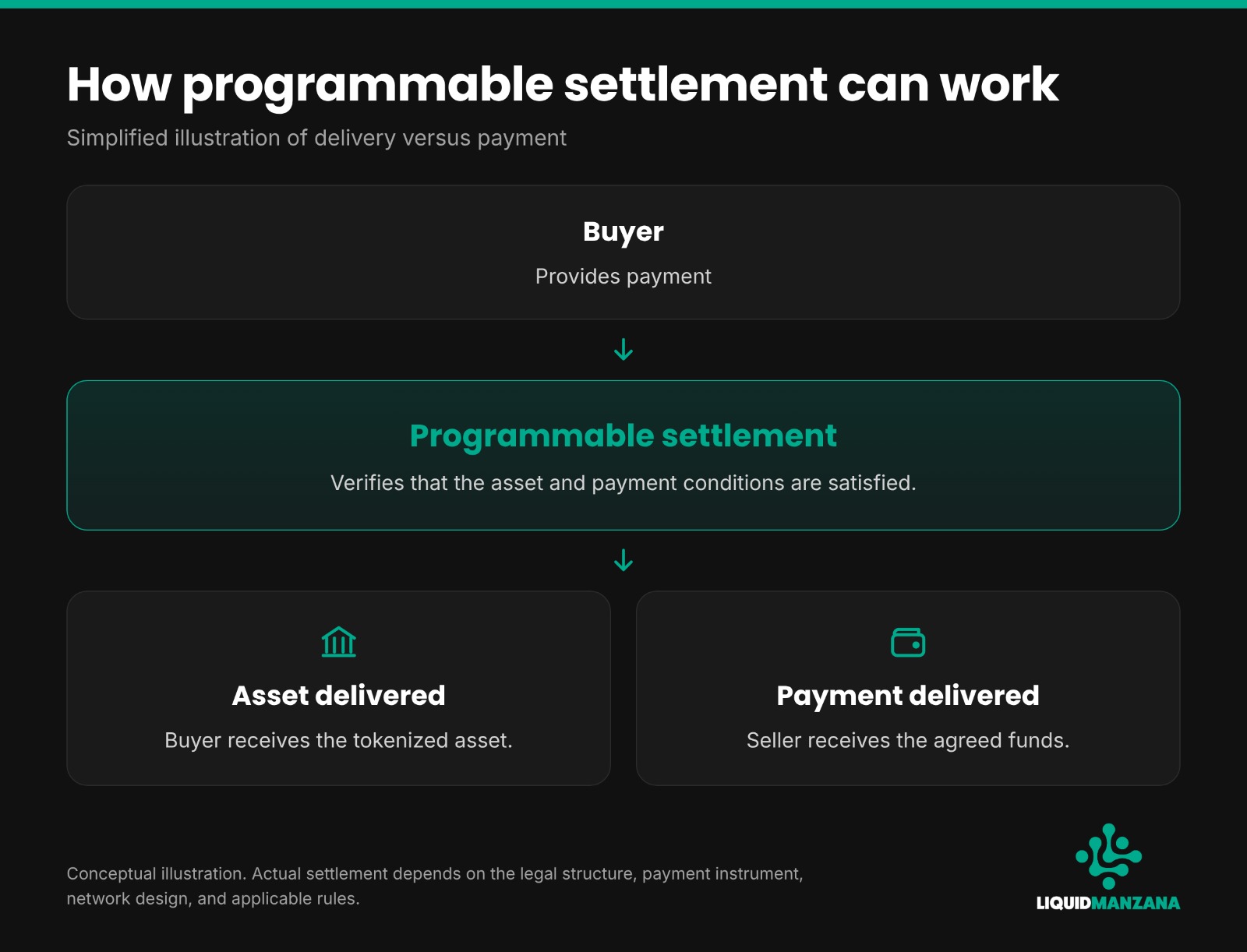
By coordinating these processes, tokenized infrastructure may reduce some settlement delays, reconciliation requirements, and counterparty exposures.
Nevertheless, a blockchain's transaction-processing speed does not necessarily determine the speed of the entire financial transaction.
Banking arrangements, investor verification, regulatory checks, payment finality, custody processes, and off-chain dependencies can still affect settlement.
The potential advantage comes from integrating these components—not merely processing tokens faster.
6. Improving Collateral Mobility and Capital Efficiency
Collateral is fundamental to modern financial markets.
Banks, investment firms, and other institutions use securities and other assets to secure financing, support derivatives transactions, and manage counterparty risk.
Yet collateral may be held across different custodians, jurisdictions, and settlement systems.
Moving an eligible asset from one location to another can require operational coordination, particularly outside traditional market hours.
Tokenization offers the possibility of improving collateral mobility through shared records, programmable transfers, and more closely connected settlement infrastructure.
In May 2026, DTCC published research examining how tokenized collateral and near-real-time asset mobility could help financial institutions improve capital efficiency, manage liquidity buffers, and move eligible assets across market infrastructure. These were potential benefits assessed in the research, rather than guaranteed outcomes for every implementation.
For example, a financial institution holding eligible government securities might be able to mobilize those assets more efficiently to meet a collateral requirement, subject to applicable rules and the capabilities of participating systems.
This could become especially relevant as financial institutions explore extended trading hours and increasingly interconnected markets.
However, the effectiveness of tokenized collateral depends on several conditions.
The receiving institution must recognize the asset and its associated rights. Custody arrangements must support the transfer. Applicable regulations must permit the transaction. Valuation and eligibility information must be reliable, and settlement finality must be legally established.
Tokenization may improve the movement of collateral, but it does not change the underlying asset's credit quality or eliminate collateral-management risk.
7. Fractionalization, Market Access, and the Liquidity Question
One of the most frequently discussed features of tokenization is fractionalization: the ability to represent an asset or investment interest through smaller digital units.
This capability may create new possibilities for issuance, portfolio construction, and distribution.
However, three concepts must remain distinct.
Three concepts that are often confused

A tokenized real estate interest, for example, may be divided into thousands of units. That division does not necessarily create a secondary market for those units.
Actual liquidity requires willing buyers and sellers, appropriate trading venues, reliable pricing, eligible participants, custody, payment infrastructure, and applicable regulatory permissions.
Some tokenized securities may remain subject to resale restrictions or investor-eligibility requirements.
Consequently, a technically transferable token may still be difficult to sell.
Tokenization can potentially improve the infrastructure supporting secondary markets, but market liquidity ultimately depends on economic demand and the conditions under which transactions can occur.
8. Private Markets and the Potential for Operational Modernization
Private markets present another area where tokenization may introduce meaningful operational changes.
Private credit, private equity, venture capital, real estate, and infrastructure investments often involve complex documentation, investor eligibility requirements, periodic reporting, and relatively infrequent transfers.
Tokenization can potentially support these activities through digital ownership records, programmable restrictions, and more integrated administrative processes.
Consider a private credit investment.
The underlying loan still depends on the borrower's ability to repay, the quality of underwriting, contractual protections, collateral arrangements, and the effectiveness of loan servicing.
A tokenized structure does not change those fundamentals.
However, blockchain-based infrastructure could help coordinate ownership records, permitted transfers, payment distributions, and reporting.
Similarly, tokenized private equity fund interests could support more automated investor administration while preserving the fund's governing documents and transfer restrictions.
The economic characteristics of private investments remain important.
Tokenization does not eliminate illiquidity, valuation uncertainty, credit risk, or the possibility of investment losses.
Its potential contribution is to improve the infrastructure through which these investments are issued, held, and administered.
9. Cross-Border Capital Markets and Interoperability
Capital markets are global, but financial infrastructure is often organized around national jurisdictions, domestic payment systems, and institution-specific technology.
Cross-border transactions may involve currency conversion, international custody arrangements, different settlement cycles, and overlapping regulatory obligations.
Tokenization introduces opportunities to connect some of these processes through shared digital infrastructure.
For example, a tokenized investment instrument could potentially be distributed to eligible investors across multiple jurisdictions through compatible systems.
However, technical accessibility is not equivalent to legal accessibility.
An investor's ability to interact with a blockchain does not automatically establish their eligibility to purchase a security.
Cross-border tokenized markets must still address securities laws, offering restrictions, anti-money laundering requirements, sanctions screening, tax obligations, custody, and applicable foreign-exchange controls.
Interoperability also presents technical challenges.
Different blockchain networks, custody providers, payment systems, and traditional financial institutions may use different standards.
DTCC has emphasized interoperability and the preservation of established legal and regulatory safeguards as central requirements for connecting traditional and digital capital markets.
Without common standards and reliable connections between systems, tokenization could introduce new forms of market fragmentation rather than reducing existing ones.
10. Why Legal Rights and Regulatory Recognition Remain Essential
The technical ability to create a token is not equivalent to establishing a legally enforceable financial instrument.
For tokenized RWAs, the legal structure determines what investors actually own or are entitled to receive.
Depending on the asset and jurisdiction, this may involve securities law, property law, trust arrangements, fund regulation, contractual rights, or other legal frameworks.
A tokenized security should therefore be understood in relation to its underlying legal rights rather than its technical characteristics alone.
Regulatory treatment can also differ significantly across jurisdictions and asset classes.
In the United States, for example, the SEC announced a conditional five-year exemption for certain tokenized-stock trading arrangements in September 2026. According to contemporaneous reporting, the framework distinguishes tokenized shares carrying ordinary shareholder rights from synthetic instruments that merely track stock prices.
The distinction illustrates why token design, legal rights, and regulatory treatment must be considered together.
Beyond issuance, institutions must also address investor verification, custody, disclosures, market conduct, reporting, cybersecurity, dispute resolution, and governance.
Effective tokenization requires legal and operational arrangements that remain enforceable throughout the asset's lifecycle.
11. The Emerging RWA Value Chain
As tokenization develops, a broader ecosystem of financial and technical service providers is emerging.
An operational tokenized-asset market requires much more than issuers and blockchain developers.

The tokenized RWA value chain
An illustrative sequence of the functions supporting an asset from origination through exit.
- Asset origination and legal structuring
Asset owners, issuers, fund managers, legal advisers, and valuation specialists establish the asset, its economic characteristics, and the rights associated with the token. - Issuance and compliance
Technology providers, regulated intermediaries, and identity-verification services support token creation, disclosures, eligibility, and distribution. - Custody and administration
Custodians, fund administrators, asset servicers, auditors, and data providers support secure holding, reporting, and ongoing asset management. - Transfer, trading, and settlement
Eligible participants, trading venues, brokers, payment providers, and settlement infrastructure support permitted transactions. - Redemption, maturity, or exit
Issuers and administrators coordinate final distributions, asset sales, redemptions, and the corresponding updates to legal and blockchain records.
Some organizations may perform multiple functions, while others specialize in a particular part of the lifecycle.
Traditional financial institutions may also adapt their existing roles rather than disappear.
Custodians, for example, may need to manage cryptographic keys alongside established safekeeping and asset-servicing responsibilities.
Administrators may need to reconcile blockchain records with underlying financial information.
Regulated intermediaries may need to connect traditional investor-onboarding processes with blockchain-based distribution and settlement.
The development of this value chain is essential because tokenized assets remain dependent on real-world institutions, contractual relationships, and operational processes.
12. Measuring Adoption Beyond Market Capitalization
The growth of tokenized RWAs is frequently discussed through market-size estimates.
These figures can provide useful context, but they should be interpreted carefully.
McKinsey's June 2024 research estimated that tokenized financial assets could reach approximately $2 trillion by 2030 in its base case, excluding cryptocurrencies and stablecoins. The analysis anticipated adoption across multiple asset classes and emphasized that widespread deployment would require coordination across financial-market participants. This is a dated forecast, not a measurement of the market's current size.
A more complete understanding of tokenization requires several indicators.
Outstanding tokenized value measures the economic value currently represented through qualifying structures.
Primary issuance measures the value of new tokenized instruments created during a particular period.
Transaction and settlement activity can indicate how actively the infrastructure is being used.
Secondary-market turnover, pricing, and trading activity provide information about actual market liquidity.
The number of economically distinct issuers, programs, and underlying assets can help measure the breadth of adoption.
Investor participation, custody capabilities, regulated issuance, and ongoing servicing provide additional information about institutional and operational development.
These metrics should not be treated as interchangeable.
A large amount of tokenized value may coexist with limited trading activity. A system processing substantial transaction volume may hold relatively little value at any given moment. A large number of token contracts may represent only a small number of economically distinct assets.
Meaningful adoption requires understanding what each measurement represents.
13. The Challenges That Could Limit Adoption
Despite the potential benefits, tokenization faces significant obstacles.
Financial markets depend on reliability, legal certainty, operational resilience, and trust. Introducing new infrastructure must preserve those characteristics while demonstrating practical improvements.
Several challenges remain particularly important.
Regulatory fragmentation. Different jurisdictions may classify and regulate tokenized instruments differently, complicating issuance, distribution, and cross-border transfers.
Interoperability. Blockchain networks, traditional financial systems, custody platforms, and payment providers must be able to exchange information and coordinate transactions reliably.
Cybersecurity and custody. Cryptographic key management, smart-contract vulnerabilities, operational controls, and incident response introduce risks that institutions must manage.
Legal enforceability. The relationship between tokens, underlying assets, and investor rights must remain clear and enforceable.
Market liquidity. Technical transferability does not guarantee sufficient demand, reliable price discovery, or functioning secondary markets.
Data quality. Blockchain can provide verifiable transaction records, but it cannot independently guarantee that valuations, collateral information, or other off-chain data are accurate.
Economic viability. Tokenization must provide benefits sufficient to justify implementation, integration, compliance, and ongoing operational costs.
These challenges help explain why adoption is likely to vary across asset classes and jurisdictions.
A standardized government security may be easier to integrate into tokenized financial infrastructure than an asset requiring complex ownership documentation, uncertain valuation, or extensive physical servicing.
14. The Future: Integration Rather Than Replacement
The long-term significance of tokenization may depend less on replacing existing financial institutions and more on changing how those institutions interact.
Banks, custodians, exchanges, asset managers, clearing organizations, and regulators already perform functions essential to capital markets.
Blockchain infrastructure may allow some of these functions to be coordinated differently, particularly where shared records, programmable transactions, and compatible payment systems offer measurable advantages.
The BIS has proposed a model in which tokenized central bank money, commercial bank deposits, and government securities operate through integrated programmable financial infrastructure. This is a proposed architecture rather than a universally deployed system, but it illustrates how tokenization could connect financial assets and settlement money more closely.
Institutional initiatives are also demonstrating ways to connect traditional securities systems with blockchain-based processes without abandoning established legal protections.
The eventual architecture of tokenized capital markets may include public blockchains, permissioned networks, traditional databases, and hybrid arrangements.
Different assets and financial activities may require different solutions.
What matters is whether those systems can operate together reliably while maintaining appropriate governance, investor protections, and regulatory compliance.
Conclusion: A Change in Financial Infrastructure
Tokenized real-world assets are reshaping the discussion around capital markets because they introduce new ways to represent, administer, transfer, and settle financial rights.
Their potential extends across primary issuance, investment funds, fixed income, private markets, collateral management, cross-border transactions, and settlement.
However, tokenization does not automatically create liquidity, reduce investment risk, eliminate intermediaries, or establish legally enforceable ownership.
Those outcomes depend on the underlying asset, market conditions, legal structure, institutional arrangements, and the quality of the supporting infrastructure.
The development of tokenized capital markets will therefore require coordinated progress across technology, regulation, custody, payments, market infrastructure, and asset administration.
Sources:
- https://www.bis.org/media-releases/20250624-next-generation-monetary-and-financial-system-takes-shape-based-tokenised-unified-ledger-bis
- https://www.dtcc.com/press-releases/2026/dtcc-turns-tokenization-into-reality
- https://www.dtcc.com/press-releases/2026/tokenized-collateral-could-unlock-billions-in-capital-and-transform-liquidity-management
- https://www.dtcc.com/press-releases/2026/dtcc-advances-development-of-new-tokenization-service
- https://www.mckinsey.com/industries/financial-services/our-insights/from-ripples-to-waves-the-transformational-power-of-tokenizing-assets
- https://www.sec.gov/newsroom/press-releases/2026-90-sec-issues-innovation-exemption-facilitate-trading-tokenized-nms-stock-request-comment