
Tokenization Is More About Infrastructure Than Crypto

Why the future of tokenized real-world assets depends on financial infrastructure, legal frameworks, and operational integration, not simply blockchain technology.
When people hear the word tokenization, they often associate it with cryptocurrencies, digital tokens, and blockchain trading. While these technologies are important components of tokenization, they represent only part of a much larger transformation.
The broader opportunity lies in how financial assets are issued, recorded, administered, transferred, and settled.
Tokenized real-world assets (RWAs) illustrate this distinction. By representing legally defined rights in assets such as government securities, investment funds, private credit, real estate, and commodities, tokenization introduces the possibility of connecting traditional financial instruments with programmable digital infrastructure.
But creating a token does not automatically create a functioning financial product.
Tokenization is fundamentally an infrastructure challenge, not simply a cryptocurrency application.
Beyond the Token
Creating a digital token on a blockchain is relatively straightforward. Establishing the legal, financial, and operational systems that make the token meaningful is considerably more complex.
A tokenized asset requires an identifiable underlying asset, clearly defined investor rights, appropriate legal structuring, regulatory compliance, secure custody, reliable administration, and mechanisms for transferring or redeeming those rights.
Consider a tokenized private credit investment. The blockchain may record ownership interests and facilitate permitted transfers, but the underlying loans still require underwriting, borrower monitoring, payment collection, reporting, and enforcement of contractual obligations.
The token does not replace these responsibilities. It introduces another way to coordinate them.
The same principle applies to tokenized investment funds, government securities, and real estate interests.
Without the supporting infrastructure, a token is merely a digital representation whose practical financial utility may be limited.
Connecting Fragmented Financial Systems
Traditional financial markets depend on numerous institutions and technological systems.
Issuers, custodians, broker-dealers, banks, fund administrators, clearing organizations, and settlement providers often maintain separate records and perform different parts of a transaction.
Although these arrangements serve important legal and operational purposes, they can also create reconciliation requirements, processing delays, and coordination challenges.
Blockchain infrastructure introduces the possibility of shared records and programmable transactions that connect some of these processes more directly.
For example, compatible tokenized asset and payment systems may support delivery-versus-payment settlement, in which an asset transfer and its corresponding payment are executed conditionally.
Similarly, tokenized collateral infrastructure may help institutions move eligible assets between participating systems more efficiently.
These applications address existing financial activities rather than creating entirely new asset classes.
The objective is not necessarily to eliminate financial intermediaries. It is to improve how institutions exchange information, coordinate responsibilities, and transfer value.
The Infrastructure That Makes Tokenization Work
A functioning tokenized RWA ecosystem depends on several interconnected components.
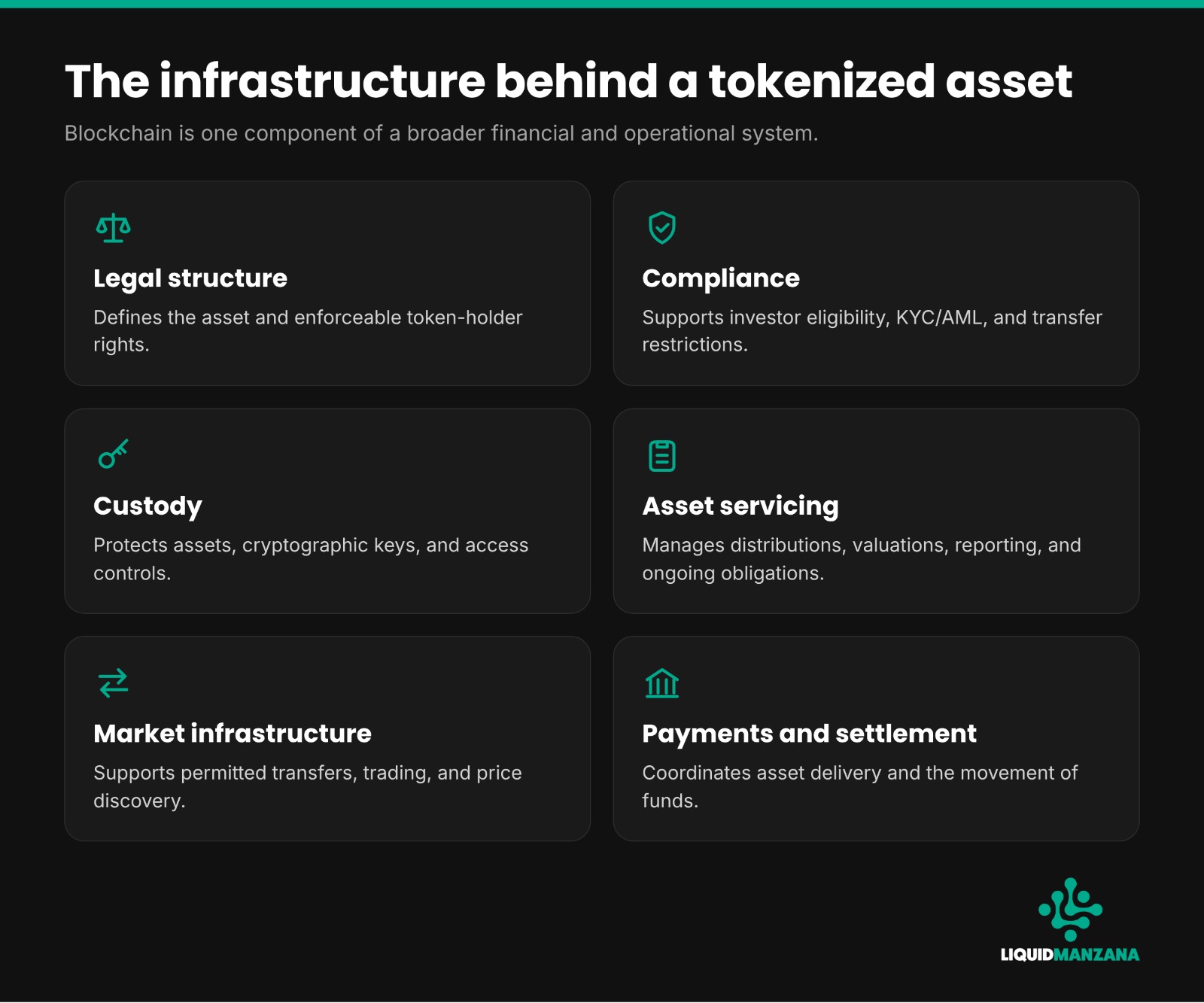
These components must operate together throughout the asset's lifecycle, from issuance to maturity, redemption, or sale.
A blockchain may provide an efficient record of transactions, but it cannot independently verify every off-chain event, guarantee the accuracy of an asset valuation, or establish the legal enforceability of an investor's rights.
Those responsibilities remain dependent on appropriate institutions, governance, and legal arrangements.
Why Liquidity Requires More Than Tokenization
One of the most persistent assumptions about tokenization is that dividing an asset into smaller digital units automatically makes it liquid.
It does not.
Fractionalization can make an asset divisible. Blockchain may facilitate technically efficient transfers. But actual liquidity requires willing buyers and sellers, reliable pricing, appropriate trading venues, eligible participants, and functioning settlement infrastructure.
A tokenized real estate interest, for example, may be divided into thousands of units while remaining difficult to sell.
Likewise, a tokenized security may be technically transferable but legally restricted to certain categories of investors.
Fractionalization, transferability, and liquidity are three different characteristics.
Building functioning markets around tokenized assets therefore requires much more than deploying smart contracts.
It requires the financial infrastructure and economic conditions necessary to support actual transactions.
From Crypto Experimentation to Institutional Integration
Institutional interest in tokenization increasingly centers on established financial activities, including investment funds, government securities, collateral management, payments, and settlement.
These applications demonstrate why tokenization should not be evaluated solely through cryptocurrency adoption or the number of tokens created.
An institution may use blockchain infrastructure to improve fund administration or collateral mobility without participating in speculative cryptocurrency markets.
Similarly, a tokenized government security remains fundamentally a government security. Its economic characteristics, legal rights, and underlying risks do not disappear because its ownership is represented on blockchain.
The relevant question is whether the technology improves the processes surrounding the asset.
This shift in perspective also changes how adoption should be measured. Outstanding tokenized value is useful, but recurring institutional transactions, regulated issuance, operational reliability, settlement activity, and integration with existing financial systems provide additional evidence of market development.
Building the Next Layer of Financial Infrastructure
The long-term development of tokenization will depend on connecting blockchain technology with the institutions and systems that already support financial markets.
That includes regulatory frameworks, legal enforceability, digital identity, cybersecurity, custody, payment networks, asset administration, and interoperability between traditional and blockchain-based infrastructure.
Different markets may adopt different architectures. Some applications may use public blockchains, others permissioned networks, and many may combine blockchain with established financial systems.
The important question is not which technology is used in isolation, but whether the complete system can operate reliably, securely, and in accordance with applicable requirements.
Tokenization does not need to replace traditional finance to become useful. Its potential lies in improving how existing financial activities are coordinated and executed.
The future of tokenized RWAs will depend less on how many tokens are created and more on whether the infrastructure surrounding them can support real financial activity.