
Tokenization Is a Process, Not a Moment
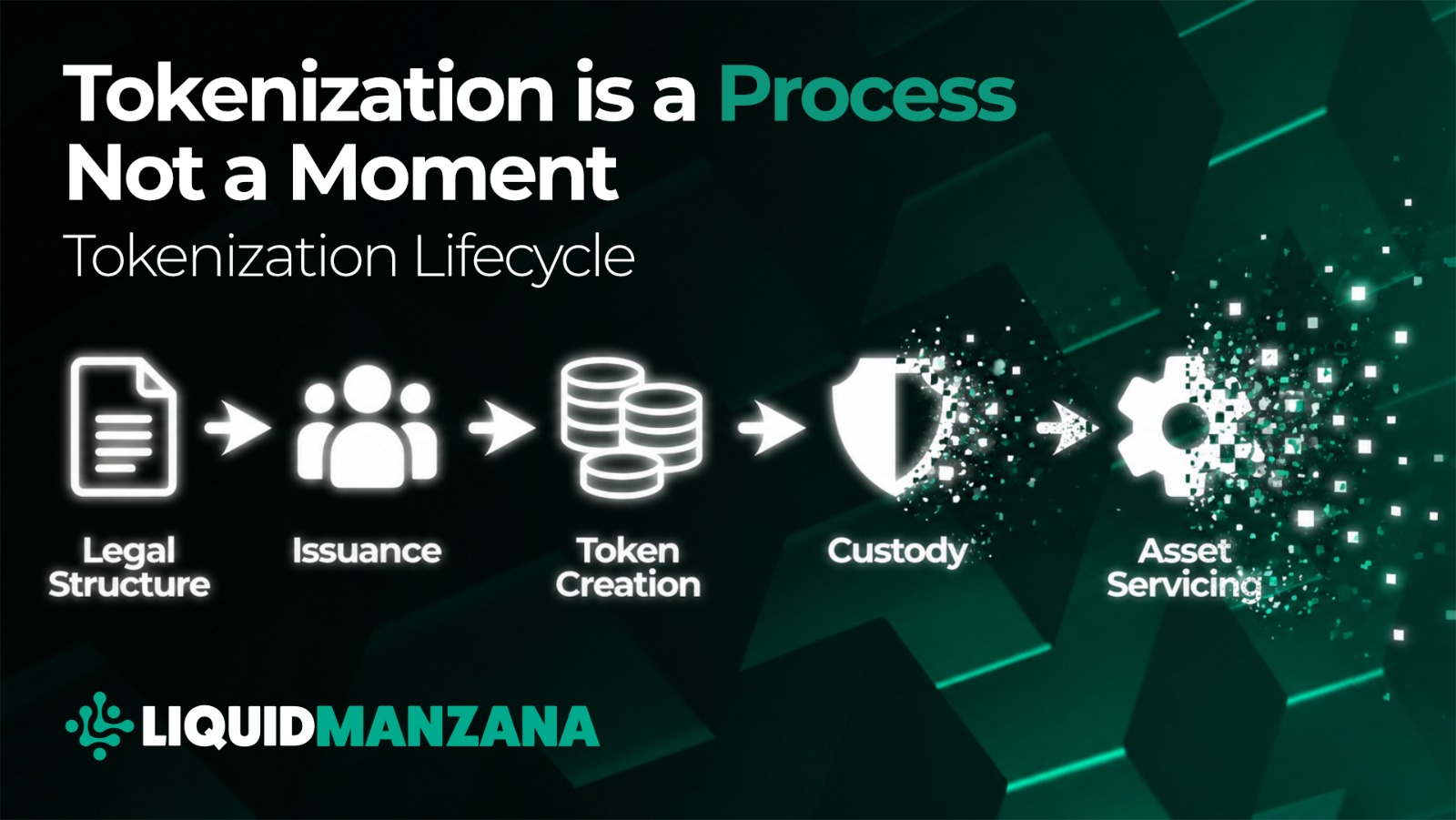

Why creating a token is only one step in building functional digital asset infrastructure
When people talk about tokenizing real-world assets, the conversation often focuses on the moment an asset becomes a token on a blockchain.
But that moment is only one part of a much larger process.
A tokenized real-world asset (RWA) exists at the intersection of legal rights, financial structures, technology, custody, compliance, administration, and settlement. Creating the digital token may be technically straightforward. Building the infrastructure that allows that token to represent clearly defined rights and operate throughout the life of an asset is considerably more complex.
Understanding tokenization therefore requires looking beyond token creation.
It Starts With the Legal Structure
Before an asset is represented on a blockchain, there must be clarity about what the token actually represents.
A token could represent equity in an entity, a debt instrument, an interest in a fund, contractual rights, or another legally recognized interest associated with an underlying asset.
This distinction matters because owning a digital token does not automatically mean owning the physical asset referenced by it.
The applicable contracts, offering documents, ownership structure, and regulatory framework establish the rights of token holders. The blockchain can record and facilitate transactions involving those rights, but it does not independently create their legal enforceability.
Issuance Connects the Asset With Investors
Once the structure is established, the asset can move toward issuance.
Depending on the jurisdiction and characteristics of the instrument, this process may involve securities regulation, investor eligibility requirements, disclosures, Know Your Customer (KYC) procedures, Anti-Money Laundering (AML) controls, sanctions screening, and transfer restrictions.
Only after the appropriate requirements are satisfied can eligible participants acquire the tokenized interest.
This demonstrates an important distinction between technical accessibility and legal accessibility.
A blockchain network may be globally accessible, but that does not mean every participant is legally permitted to purchase or receive every tokenized asset.
Custody Determines Access and Control
After issuance comes another fundamental question: who controls the digital asset?
Blockchain-based assets rely on cryptographic keys. Custody structures determine how those keys, and therefore access to the assets, are protected and managed.
Different structures may involve self-custody, institutional custodians, multi-signature arrangements, multi-party computation, or hybrid approaches.
For institutional participants, custody can also involve cybersecurity, transaction authorization, governance, recovery procedures, auditability, reporting, and regulatory oversight.
Custody is therefore not simply about where a token is “stored.” It is about how access, control, security, and responsibility are managed.
The Underlying Asset Still Needs to Be Serviced
Tokenization does not remove the real-world asset from the real world.
A property still needs to be managed. A borrower still needs to make payments. A commodity may still require storage and verification. A fund still requires administration, valuation, and reporting.
These activities frequently occur off-chain.
This means tokenized asset systems need mechanisms for connecting real-world events with digital infrastructure. Asset managers, servicers, administrators, auditors, custodians, data providers, and other professionals may continue to play important roles.
Smart contracts can automate certain predefined processes, but automation depends on reliable information.
Blockchain can preserve a record of information entered into a system. It cannot independently guarantee that information about the underlying asset is accurate.
Transferability Is Not the Same as Liquidity
Tokenization is also frequently associated with liquidity.
The distinction here is critical.
Creating smaller digital units can improve fractionalization. Blockchain infrastructure can potentially improve transferability. Neither automatically creates liquidity.
Liquidity requires actual market conditions: eligible buyers and sellers, demand, reliable pricing, appropriate trading infrastructure, custody, settlement mechanisms, and regulatory permission to transfer the asset.
A $20 million asset divided into 20,000 tokens does not suddenly have 20,000 buyers.
An illiquid asset can remain illiquid even when its ownership interests are represented digitally.
Settlement Completes the Transaction
When a tokenized asset changes hands, the asset and payment ultimately need to move between participants.
Blockchain infrastructure may allow ownership records, transaction execution, and settlement to become more closely connected. Depending on the structure, tokenized assets may interact with traditional banking rails, stablecoins, tokenized deposits, or other permitted payment mechanisms.
But the speed of a blockchain does not necessarily determine the speed of the complete financial transaction.
Banks, custodians, compliance systems, payment providers, marketplaces, and other infrastructure may still be involved.
The performance of the system therefore depends on how effectively all of these components work together.
Tokenization Is Infrastructure
The most useful way to think about tokenization may not be as a single technological event.
It is an end-to-end process.
The token itself is one component within a larger architecture that can include:
- Asset due diligence and valuation
- Legal structuring and documentation
- Regulatory classification and compliance
- Digital issuance
- Investor onboarding
- Custody and cybersecurity
- Asset servicing and administration
- Data and reporting
- Secondary transfer infrastructure
- Payment and settlement
- Governance
- Redemption, maturity, or exit
Each component addresses a different part of the relationship between the digital token and the real-world asset.
Conclusion
The future of tokenization is unlikely to be determined by how quickly a platform can create a token.
The more meaningful question is whether the infrastructure surrounding that token can support the asset throughout its entire lifecycle.
Legal rights must remain connected to digital records. Investors must be appropriately onboarded. Assets must be administered. Keys must be protected. Transactions must comply with applicable requirements. Payments and ownership transfers must settle correctly. And eventual redemption, maturity, or exit must be reflected in both the legal and digital systems.
That is why tokenization is a process, not a moment.
Creating the token may be the most visible step. Building the legal, financial, operational, and technological infrastructure that allows it to function responsibly in real-world markets is the larger task.