
Putting an Asset on Blockchain Doesn’t Complete Tokenization
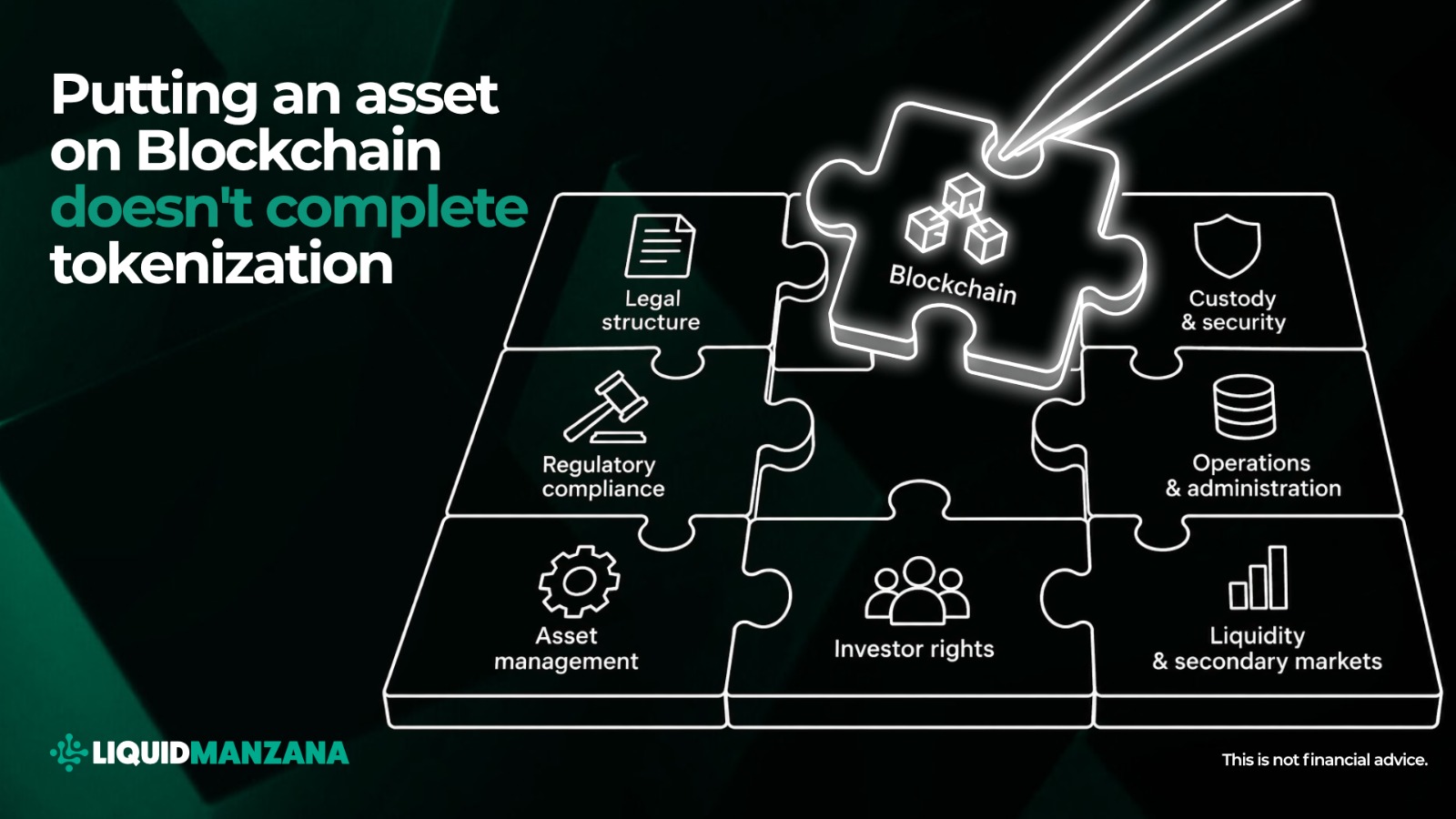

Legal rights, custody, compliance, administration, and market infrastructure still matter.
One of the easiest misconceptions about real-world asset (RWA) tokenization is that the process is complete once a token has been created on a blockchain.
It isn't.
Creating a token establishes a digital representation. For that token to function as part of a real financial or commercial system, it must be connected to a much broader infrastructure surrounding the underlying asset.
That distinction separates token creation from asset tokenization.
A Token Needs Clearly Defined Legal Rights
A blockchain can record who controls a particular token, but the blockchain alone does not determine what that token legally represents.
Does it represent equity in a company? An interest in a fund? A debt obligation? A contractual claim associated with real estate? Rights to certain distributions?
Those questions must be answered through the applicable legal structure and documentation.
For tokenized RWAs, the connection between the digital record and legally enforceable rights is fundamental. Without that connection, recording ownership of a token does not necessarily establish ownership of, or enforceable rights to, the underlying real-world asset.
Custody Still Matters
Once an asset is represented digitally, control of the token introduces another layer of responsibility.
Blockchain-based assets generally rely on cryptographic keys. Custody determines how those keys and associated transaction permissions are protected.
Depending on the structure, participants might use institutional custody, self-custody, multi-signature arrangements, multi-party computation, or hybrid approaches.
For institutional markets, custody can also involve cybersecurity, access controls, transaction authorization, recovery procedures, auditability, and governance.
Tokenization changes the form of the asset interest, but it does not eliminate the need to protect it.
Compliance Does Not Disappear On-Chain
A blockchain may operate globally and continuously, but financial regulation remains jurisdiction-specific.
A tokenized security, for example, may still be subject to requirements concerning investor eligibility, disclosures, KYC, AML, sanctions screening, marketing, custody, and secondary transfers.
This creates an important distinction between what is technically possible and what is legally permitted.
A token may technically be transferable between two wallets in seconds. That does not necessarily mean the transfer is permitted under the governing securities laws, contractual restrictions, or offering structure.
Digital infrastructure therefore needs to operate alongside the applicable compliance framework.
Real-World Assets Still Require Real-World Administration
Putting an asset on blockchain does not remove its physical, financial, or operational characteristics.
A building still requires property management. A borrower still has to make payments. Agricultural assets still need to be produced, stored, transported, or sold. Infrastructure projects still require maintenance and operation. Investment funds still require accounting, valuation, reporting, and administration.
Much of this activity occurs off-chain.
A functioning RWA system therefore needs reliable connections between real-world events and digital records.
Administrators, asset managers, servicers, auditors, custodians, valuation providers, and other specialists may remain essential even when blockchain is used as part of the infrastructure.
Market Infrastructure Determines Whether Tokens Can Actually Move
Tokenization is also frequently associated with greater liquidity.
But creating tokens does not create a market.
Fractionalization can divide an economic interest into smaller units. Blockchain can potentially make permitted transfers more efficient. Neither guarantees that buyers and sellers will exist.
Actual liquidity depends on factors such as market demand, eligible participants, pricing information, trading venues, custody, payment and settlement infrastructure, transfer restrictions, and applicable regulation.
An illiquid $10 million asset does not necessarily become liquid because it has been divided into 10,000 digital units.
Fractionalization, transferability, and liquidity are related concepts, but they are not the same thing.
The Token Is One Component of a Larger System
This is why mature tokenization should be viewed as an end-to-end process rather than a single technological event.
The complete infrastructure may involve asset selection and due diligence, legal structuring, regulatory classification, issuance, investor onboarding, custody, asset servicing, data and reporting, secondary transfers, payment and settlement, governance, and eventual redemption or exit.
Blockchain can connect and potentially automate parts of that lifecycle.
But blockchain does not replace the lifecycle itself.
Conclusion
Putting an asset on blockchain doesn't complete tokenization.
Legal rights, custody, compliance, administration, and market infrastructure still matter.
The token may be the most visible component, but the more difficult work happens around it: establishing what the token represents, connecting it to enforceable rights, protecting it, administering the underlying asset, determining who can transact, and creating the infrastructure through which permitted transactions can actually occur.
The future of RWA tokenization may therefore depend less on how easily the industry can create tokens and more on how effectively it can build the legal, financial, operational, and technological infrastructure surrounding them.
Minting is an event. Tokenization is a lifecycle.