
Why “Not Misleading” Is a Core Rule in Digital Asset Markets
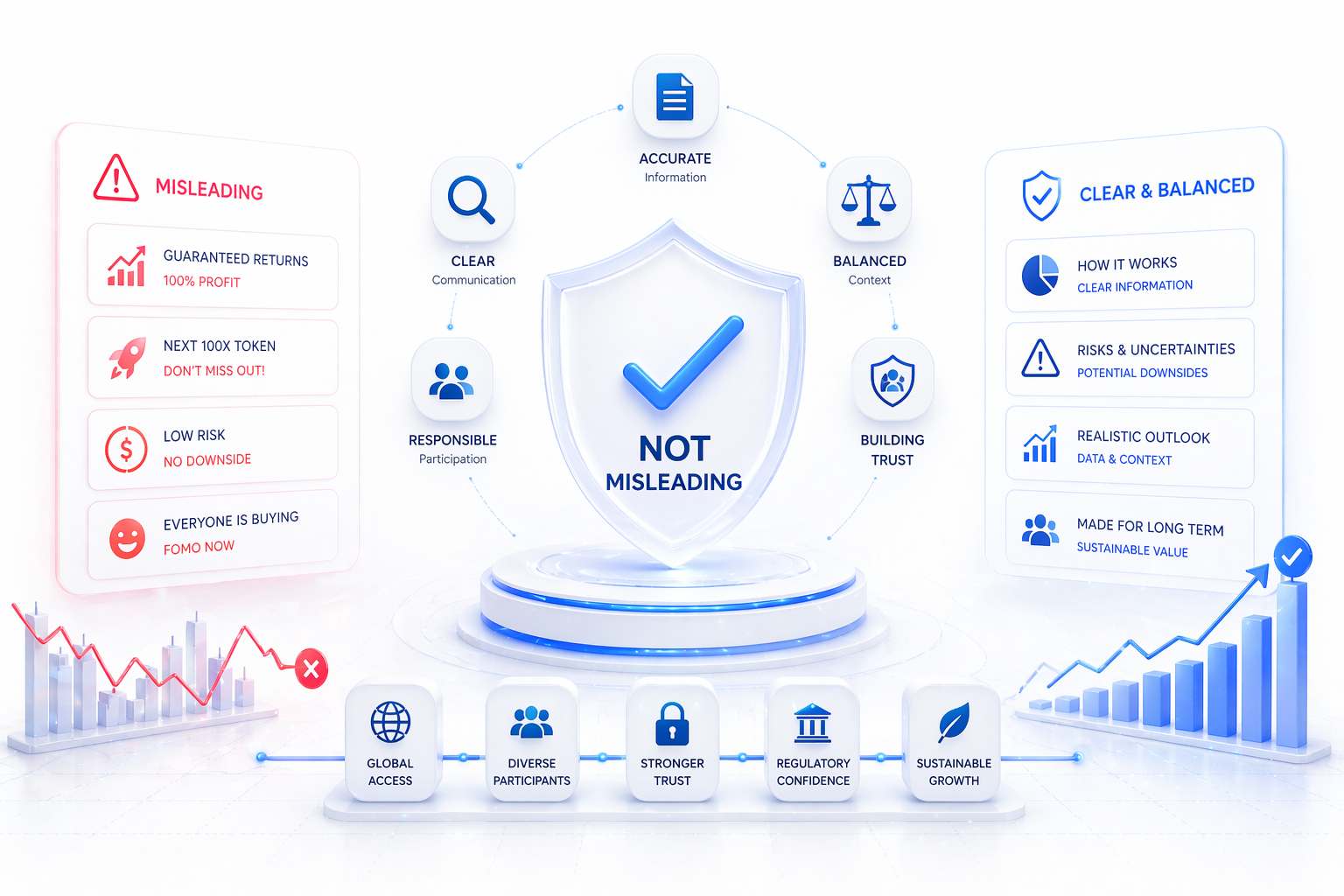

In digital asset markets, one of the most important, yet often overlooked, principles is simple: information must not be misleading. While this idea exists across all areas of finance, it carries particular weight in crypto and tokenized ecosystems, where markets are fast-moving, globally accessible, and often still developing clear standards. In these environments, how information is presented can directly influence decisions, behavior, and ultimately, market stability.
The “not misleading” standard is about ensuring that participants are given a fair and accurate representation of what an asset is, how it works, and what risks are involved. This does not mean that every statement must be overly cautious or negative, but it does mean that information should not create false impressions. For example, emphasizing potential benefits without acknowledging uncertainty, or presenting speculative outcomes as likely or guaranteed, can distort how participants understand an asset. Even if statements are technically true, they can still be misleading if they omit important context.
This becomes especially important in digital asset markets because of the diversity of participants. Unlike traditional finance, where many investors operate through intermediaries or professional advisors, crypto markets often involve direct participation from individuals with varying levels of experience. Clear and balanced communication helps ensure that less experienced participants are not unintentionally misled by incomplete or overly optimistic narratives. Without this balance, markets can become driven more by perception than by underlying fundamentals.
Another reason this principle matters is its role in maintaining trust. Markets function effectively when participants believe that information is reliable and that rules are applied consistently. If misleading statements become common, whether through marketing, social media, or informal channels, confidence can erode. Over time, this can discourage participation, increase volatility, and attract regulatory scrutiny. In contrast, environments that prioritize accurate and transparent communication tend to support more stable and sustainable growth.
Regulators around the world have increasingly emphasized the importance of non-misleading communication in digital asset markets. This includes expectations around disclosures, advertising, and public statements made by platforms, issuers, and promoters. The goal is not to restrict innovation, but to ensure that innovation is built on a foundation of clarity and accountability. As digital assets become more integrated into broader financial systems, these expectations are likely to become more standardized and more strictly enforced.
The concept of “not misleading” also extends beyond formal disclosures into everyday communication. Blog posts, social media content, whitepapers, and even community discussions all contribute to how assets are perceived. This means that responsibility is shared across the ecosystem. Platforms must design clear interfaces and disclosures, issuers must communicate accurately about their projects, and content creators must be mindful of how their messaging may be interpreted.
“Not misleading” is not just a compliance requirement, it is a foundational principle for building credible markets. Digital assets are still evolving, and their long-term success depends on trust, transparency, and informed participation. By prioritizing clear and balanced communication, the industry can move beyond short-term narratives and toward a more mature, resilient financial ecosystem where participants can engage with confidence.