
Why “Get Rich Quick” Narratives Hurt Markets
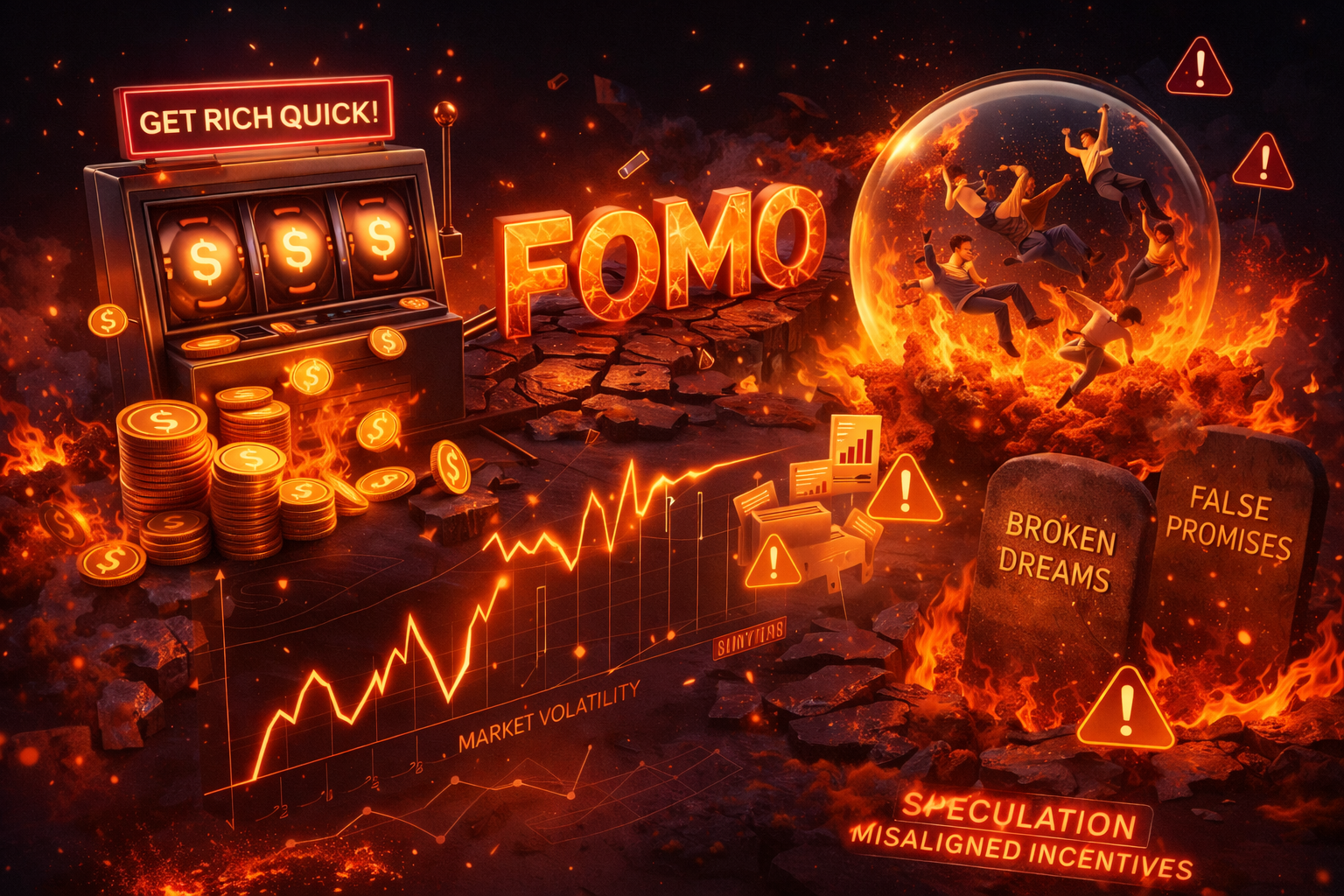

In every financial cycle, moments of rapid growth are often accompanied by a familiar message: the idea that wealth can be achieved quickly, easily, and with minimal risk. While these “get rich quick” narratives can attract attention and drive short-term participation, they tend to distort how markets function over time. Instead of encouraging informed decision-making and sustainable growth, they shift focus toward speculation, unrealistic expectations, and short-lived momentum.
One of the main issues with these narratives is that they misalign incentives. Markets work best when participants are focused on understanding value, whether that comes from cash flows, utility, or long-term adoption. When the dominant narrative becomes centered on quick profits, attention moves away from fundamentals and toward timing the next price spike. This creates an environment where decisions are driven less by analysis and more by emotion, particularly fear of missing out (FOMO). As a result, capital often flows into assets not because of their underlying value, but because of perceived short-term upside.
This dynamic can lead to increased volatility and fragility. When prices are driven primarily by speculation, they can rise quickly, but they can also fall just as fast. Markets become more sensitive to sentiment shifts, rumors, and external shocks. Participants who entered based on expectations of rapid gains may exit just as quickly when conditions change, amplifying downward movements. Over time, this cycle of rapid inflows and outflows can undermine confidence and make markets appear unstable or unpredictable.
“Get rich quick” narratives also tend to exclude or harm less experienced participants. New entrants, often drawn in by the promise of easy returns, may not fully understand the risks involved. Without a clear understanding of market structure, liquidity, or downside scenarios, they are more vulnerable to losses. In many cases, those who enter later in a hype cycle are the ones most exposed when momentum reverses. This can create a pattern where early participants benefit disproportionately, while newer participants bear a greater share of the risk.
Beyond individual outcomes, these narratives can damage the credibility of entire sectors. When markets become associated with speculation rather than utility or innovation, it becomes more difficult to build long-term trust. Institutional participants, regulators, and broader audiences may view the space as unreliable or overly risky. This perception can slow adoption, limit capital inflows from more stable sources, and delay the development of more robust infrastructure.
There is also a misunderstanding of what sustainable wealth creation looks like. In most financial systems, value tends to accrue over time through consistent growth, compounding, and the development of real economic activity. While short-term gains are possible, they are rarely predictable or repeatable at scale. Narratives that suggest otherwise can create unrealistic expectations, leading participants to underestimate risk and overestimate potential returns.
A healthier market environment is one where education, transparency, and realistic expectations take precedence over hype. This includes clear communication about risks, a focus on how assets generate value, and an emphasis on long-term participation rather than short-term speculation. Platforms, content creators, and market participants all play a role in shaping these narratives. By prioritizing accuracy over excitement, they can help foster a more stable and inclusive ecosystem.
Ultimately, markets are not harmed by growth or enthusiasm, they are strengthened by it when it is grounded in understanding. The challenge arises when excitement becomes disconnected from reality. Moving away from “get rich quick” thinking and toward informed participation is not just better for individual outcomes, it is essential for building markets that are resilient, credible, and capable of sustaining long-term value.