
Tokenized Real Estate vs. REITs
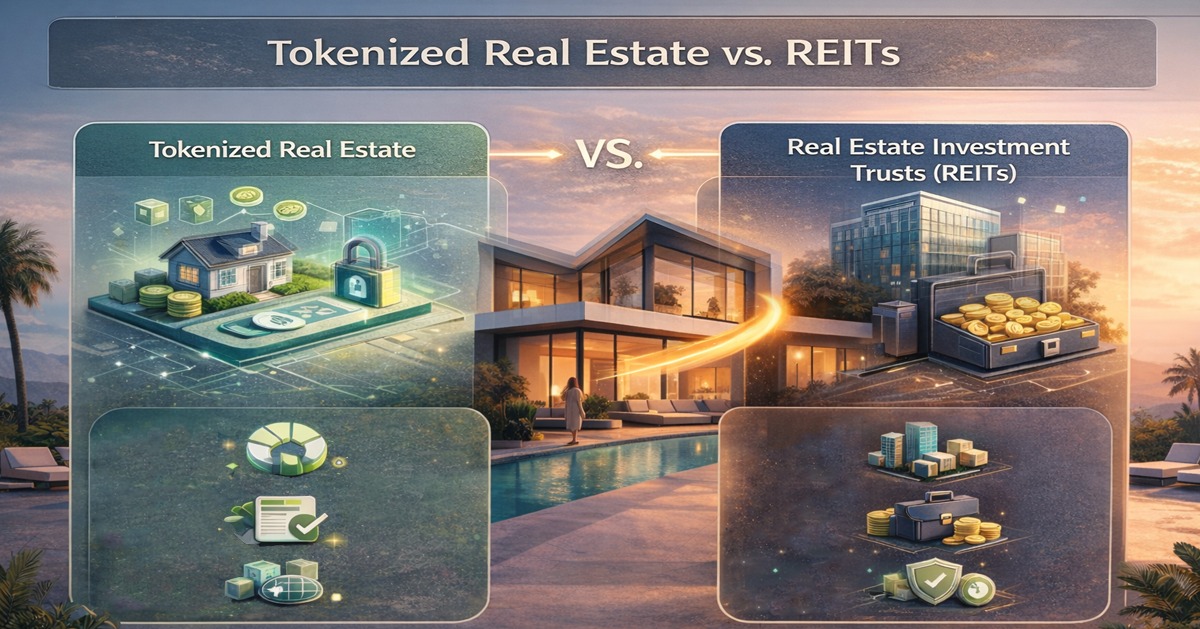

Today, we explain how real estate investment structures are evolving from traditional REITs to tokenized models, highlighting the key differences and advantages of each approach. While REITs provide diversified, regulated exposure through centralized management, tokenized real estate enables more direct, asset-specific, and fractional ownership with lower barriers to entry while still being regulated. By adding transparency, programmability, global access, and structural flexibility, tokenization extends beyond what REITs offer and introduces a new framework for real estate investing that aligns more closely with digital markets and modern investor needs.
What Is A Real Estate Investment Trust (REIT)?
A Real Estate Investment Trust (REIT) is a company that owns, operates, or finances income-producing real estate. Instead of buying individual properties directly, investors can buy shares in a REIT, which gives them exposure to a portfolio of real estate assets such as apartments, office buildings, shopping centers, hotels, warehouses, or infrastructure. REITs were created to make real estate investing more accessible by allowing everyday investors to participate in large-scale property ownership through public or private markets.
REITs work by pooling money from many investors and using that capital to acquire or finance real estate assets. The income generated from these properties, primarily through rent, leases, or interest payments, is then distributed to shareholders. In many countries, REITs are required by law to pay out a large percentage of their taxable income as dividends. This structure makes REITs attractive to investors seeking regular income, while also providing exposure to real estate without the need to manage properties directly.
There are different types of REITs based on how they generate income. Equity REITs own and operate physical properties and earn money mainly from rent. Mortgage REITs focus on financing real estate by providing loans or purchasing mortgage-backed securities, earning income from interest payments. Hybrid REITs combine both approaches. REITs can also be publicly traded on stock exchanges, publicly registered but not traded, or privately held, offering varying levels of liquidity, transparency, and accessibility.
REITs play an important role in real estate markets by increasing liquidity and broadening participation. By turning real estate ownership into tradable shares, REITs allow investors to buy and sell exposure more easily than owning property directly. At the same time, they help channel capital into real estate development and operations at scale. While REITs do not provide direct ownership of specific properties, they have long served as a bridge between traditional real estate and financial markets, laying the groundwork for newer models such as tokenized and fractional real estate ownership.
What Are The Difference Between REITs and Tokenized Real Estate Investments?
REITs and tokenized real estate investments both give investors exposure to real estate without requiring them to buy property directly, but they differ in how ownership is structured. When an investor buys shares in a REIT, they own equity in a company that manages a portfolio of properties, not a direct interest in any specific asset. Their returns depend on the overall performance of the REIT, including management decisions, operating costs, and market conditions. In contrast, tokenized real estate investments typically represent ownership or economic rights tied to a specific property or project, recorded directly on a blockchain.
Another key difference is transparency and ownership records. REIT ownership is tracked through traditional financial systems, such as brokerages and centralized registries, and investors rely on periodic disclosures to understand portfolio performance. Tokenized real estate uses blockchain-based ledgers, where ownership, transfers, and sometimes income distributions can be recorded in real time and verified publicly. This creates a clearer, more direct link between the investor and the underlying asset, reducing reliance on intermediaries for record-keeping and verification.
Liquidity and accessibility also differ between the two models. Publicly traded REITs offer strong liquidity, as shares can be bought and sold easily on stock exchanges, but they often come with market volatility tied to broader equity markets. Tokenized real estate can offer liquidity through secondary token markets and fractional ownership, allowing smaller investment sizes and more flexible participation. However, liquidity in tokenized markets depends on platform adoption and market infrastructure, which is still developing compared to traditional stock exchanges.
Regulation and control set these models apart. REITs operate under long-established regulatory frameworks and are managed by professional teams with centralized decision-making authority. Tokenized real estate investments often combine legal ownership structures with decentralized or programmable systems and regulation, using smart contracts to automate rules, distributions, with compliance built-in. While REITs offer familiarity and regulatory maturity, tokenized real estate introduces a more direct, flexible, and potentially global model of property investment that reflects how ownership and finance are evolving in the digital age.
What Benefits Does Tokenization Provide That REITs Don't?
Tokenization provides a level of direct ownership and asset specificity that REITs do not. When investing in a REIT, investors hold shares in a company that owns and manages many properties, meaning exposure is bundled and indirect. With tokenized real estate, investors can gain exposure to a specific property or project, with ownership or economic rights recorded at the asset level. This allows investors to choose exactly which properties they want exposure to, rather than relying on a management team’s portfolio decisions.
Another major advantage of tokenization is fractionalization with finer granularity. While REIT shares are already divisible, tokenization allows assets themselves to be broken into much smaller ownership units, often with lower minimum investments than REITs. This enables broader participation, especially for investors who want to allocate small amounts of capital across multiple properties, regions, or strategies. Tokenization turns real estate from a large, bundled investment into something that can be built piece by piece, similar to constructing a diversified digital portfolio.
Tokenization also introduces greater transparency and programmability than traditional REIT structures. Ownership records, transfers, and sometimes income distributions can be recorded on immutable ledgers, allowing investors to independently verify asset data rather than relying solely on quarterly reports or centralized disclosures. Smart contracts can automate distributions, compliance rules, and governance logic, reducing administrative overhead and minimizing human error. This creates a more auditable and efficient ownership system that operates continuously rather than in reporting cycles.
Tokenized real estate offers global reach and structural flexibility that REITs struggle to match. REITs are typically bound to specific jurisdictions, exchanges, and market hours, while tokenized assets can be accessed globally and traded continuously, subject to compliance rules. Tokenization also allows for customized structures, such as time-based rights, revenue-specific tokens, or hybrid models that combine debt and equity features. These capabilities position tokenization as not just an alternative to REITs, but as a fundamentally new investment framework that expands how real estate ownership, liquidity, and participation can function in a digital economy.