
How Has Ownership Been Recorded Through History?
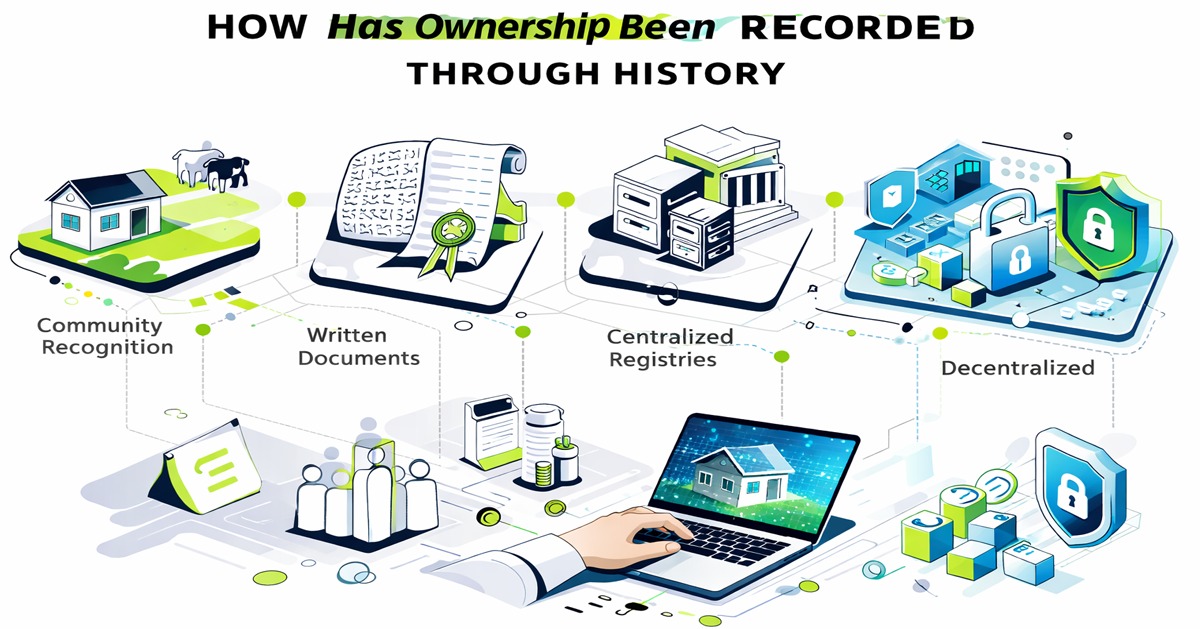

In this post, we explore how ownership records have evolved from simple community recognition and physical possession to written documents, centralized registries, and digital databases, highlighting how each step improved scale and coordination but introduced new limitations. It outlines the key problems in modern ownership systems, including centralization, inefficiency, lack of transparency, and exclusion. Finally, it shows how decentralized systems, cryptography, and tokenization offer a new model for ownership records that are more secure, transparent, efficient, and globally accessible, better aligned with a digital and connected economy.
How Did People Verify Ownership In The Past?
Ownership has been recorded in many different ways throughout history, starting with very simple methods. In early societies, ownership was often based on physical possession and community memory. If a person used a piece of land, tools, or animals, and the community recognized it as theirs, that was considered proof of ownership. There were no written records, and trust came from shared customs, traditions, and social agreement rather than formal documentation.
As societies grew larger and more organized, written records became important. Ancient civilizations began using clay tablets, carvings, or scrolls to record ownership of land, goods, and debts. These early ledgers helped reduce disputes by creating a shared reference that could be checked later. Over time, written deeds, contracts, and titles became common, especially for land and property, allowing ownership to be recorded beyond personal memory or physical control.
During the rise of modern governments and legal systems, ownership records became more formal and centralized. Registries, courts, and notaries were created to store official documents proving who owned what. Banks and corporations kept detailed ledgers to track money, shares, and assets. Ownership was increasingly represented by paperwork and official stamps, making it easier to transfer property, enforce rights, and support growing trade and markets.
In the digital age, ownership records have moved from paper to computers. Databases, electronic ledgers, and online systems now track everything from bank balances to stock ownership. More recently, blockchains have introduced a new way to record ownership using shared, tamper-resistant digital ledgers that do not rely on a single authority. This evolution shows a clear pattern: ownership records continue to move toward systems that are more durable, transparent, and easier to verify as technology advances.
What Are The Shortcomings Of Modern Systems For Ownership Tracking?
Modern systems for ownership tracking still rely heavily on centralized institutions, which creates several weaknesses. Most ownership records are stored in isolated databases controlled by governments, banks, or private companies. These systems often do not talk to each other, making it difficult to verify ownership across borders or institutions. When one authority controls the record, errors, corruption, or system failures can affect everyone who depends on it, creating single points of failure in critical ownership infrastructure.
Another major shortcoming is inefficiency. Many ownership systems are built on outdated technology that requires manual processes, paperwork, and long approval times. Transferring ownership of assets like real estate, vehicles, or financial instruments can take weeks or even months. This slow pace increases costs, limits liquidity, and prevents people from accessing or using their assets when they need to. The friction in these systems discourages participation and slows economic activity.
Transparency is also limited in modern ownership tracking systems. In many cases, only institutions or authorized intermediaries can see or verify ownership records. Individuals must trust that records are accurate without being able to independently confirm them. This lack of visibility makes disputes harder to resolve, increases the risk of fraud, and creates uncertainty around who truly owns an asset at any given time. When records are opaque, trust depends more on authority than on verifiable data.
Finally, modern ownership systems often exclude large portions of the global population. High costs, strict documentation requirements, geographic limitations, and minimum investment thresholds prevent many people from participating in asset ownership. Ownership is frequently all-or-nothing, requiring significant capital to enter. These barriers reinforce inequality and limit access to opportunity, highlighting the need for more inclusive, flexible, and technologically modern approaches to tracking and transferring ownership.
How Can Decentralized Systems, Cryptography & Tokenization Modernize Ownership Records?
Decentralized systems modernize ownership records by removing the need for a single central authority to store and control information. Instead of one government office, bank, or company keeping the official record, decentralized networks share the same record across many computers around the world. Everyone in the network can verify ownership data, which makes records harder to alter, hide, or lose. This shared structure increases resilience and reduces the risk of errors, corruption, or single points of failure.
Cryptography plays a key role by securing ownership records with strong mathematical protection. Each owner controls their assets using private cryptographic keys, which act like unbreakable digital signatures. These keys prove ownership and authorize transfers without exposing personal information. Because cryptography makes records extremely difficult to forge or change, it creates trust through technology rather than relying only on institutions or paperwork.
Tokenization takes ownership a step further by turning assets and rights into digital tokens that represent ownership on a blockchain. Real estate, shares, commodities, or even access rights can be tokenized, allowing ownership to be clearly defined, easily transferred, and recorded in real time. Tokenized assets can include built-in rules, such as transfer limits or compliance checks, which automatically enforce ownership conditions. This makes ownership records more flexible, programmable, and efficient.
Together, decentralized systems, cryptography, and tokenization transform ownership records into global, transparent, and accessible systems. Ownership can be verified instantly, transferred across borders, and divided into smaller portions without complex intermediaries. These technologies modernize how property is recorded by making ownership more secure, easier to audit, and better suited for a digital economy where assets move quickly and participation is no longer limited by geography or scale.